Carney's 'nation-building' bill lets one minister kill a lawful strike in the name of the 'national interest'
Mark Carney's Building Canada Strong Act would write sweeping new strike-breaking powers into the Canada Labour Code: once a legal strike begins, the labour minister could order workers back, extend contracts or impose arbitration — with 'national interest' left undefined. Unions call it the biggest rollback of workers' rights in generations.
By The Justice news desk
· 3 min read
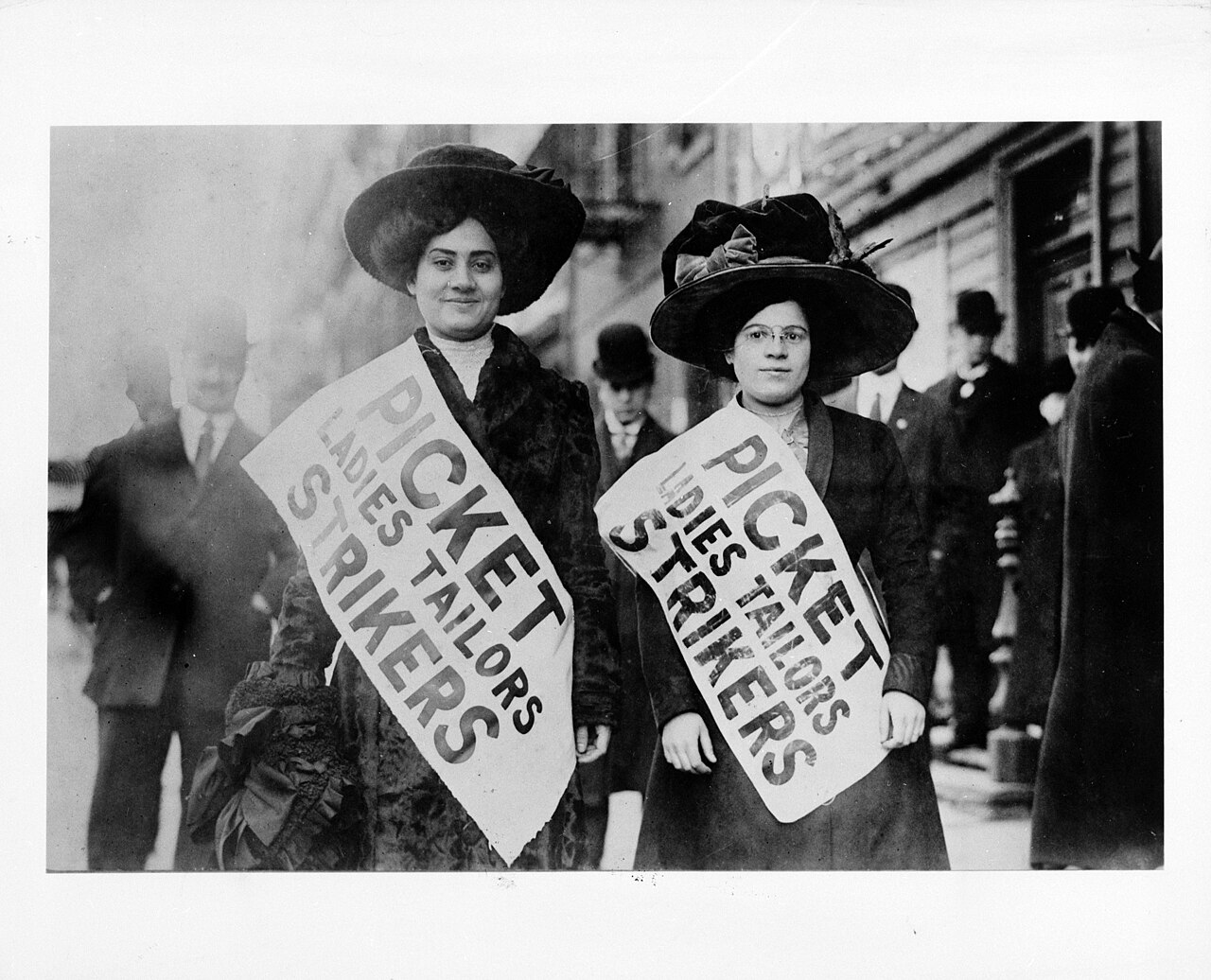
Women tailors on a picket line during the 1910 New York strike. Canadian unions say Bill C-39 would let a minister end lawful strikes like theirs. Photo: Wikimedia Commons
Canadian Prime Minister Mark Carney's government has tabled legislation that unions say amounts to one of the most significant rollbacks of workers' rights in the country's postwar history — tucked inside an omnibus bill sold as nation-building.
The Building Canada Strong Act, Bill C-39, introduced on September 21, runs to more than 230 pages. Buried in it are amendments to Section 107 of the Canada Labour Code that would give the federal labour minister explicit authority to terminate lawful strikes in federally regulated industries — rail, ports, airlines, telecommunications and postal services — and impose binding dispute resolution.
Here is how it would work. Once a legal strike or lockout has begun, the minister could direct the Canada Industrial Relations Board to order workers back to work, extend an expired collective agreement, or impose binding arbitration. A newly created "special mediator" would first report on the dispute, and the report would be made public if bargaining fails. But the final decision rests with a single minister, who need only consider that the stoppage "adversely affects or may adversely affect the national interest" — a phrase the bill does not define, and which no independent body must agree with.
The government calls these provisions "guardrails". Labour Minister Patty Hajdu insists the bill will "protect the right to strike" and "raise the bar around accountability". Carney himself said it "absolutely reinforces the right to strike."
Unions are not buying it. Canadian Labour Congress president Bea Bruske said workers "cannot have our elbow up against Trump with our hands tied behind our backs at bargaining tables" — a reference to the US trade war the government cites as justification. A CLC lawyer called the bill "the clearest possible violation" of the Charter's guarantee of freedom of association. Unifor president Lana Payne said the amendments give the minister "special authority... to override the ability of workers to exercise their right to strike." United Steelworkers national director Marty Warren put it bluntly: "The right to strike is a red line. Section 107 should be repealed, not rewritten to make it easier for the government to intervene in legal strikes." The Canadian Union of Public Employees has vowed to defy the law if it passes unamended.
The pattern is already established. Section 107 has been invoked about ten times since 2023 — against dockworkers in Montreal and on the West Coast, rail workers at CPKC and CN, Canada Post sorters and carriers, and Air Canada flight attendants. Several of those interventions are now before the courts as alleged violations of the constitution. In the Air Canada case, workers defied the back-to-work order — and won.
Critics note the wider design. Bill C-39 also fast-tracks major infrastructure approvals, weakens environmental, fisheries and species-at-risk protections, and creates sweeping powers to designate "regions of national interest". NDP figures and labour leaders describe the package as Carney's corporate remodelling of Canada: lower investment taxes and quicker project approvals for capital, and a legal padlock on the one weapon workers have — the withdrawal of their labour.
The bill's labour provisions, labour lawyers say, are headed for the Supreme Court. Until then, the message to Canadian workers is plain: your right to strike exists at the pleasure of one minister's undefined "national interest".
Two workers were killed when soil collapsed during farm-well construction in Tiruvannamalai district — the latest in a series of unsafe-site deaths across Tamil Nadu.
400 French schools shut this week as students protested teacher shortages and crumbling buildings — and the Macron government answered with riot police, 2,000 arrests and a demand that parents pay reparations. Austerity for schools, repression for schoolchildren: the state has made its choice.
From the 1965 anti-Hindi agitation to this week's Hindi boards in Thoothukudi, every 'mistake' that needs opposition outrage to fix is a test balloon. A government that runs on reels cannot be trusted with a language built on struggle.
Christa Pike survived Tennessee's attempt to execute her and now lies unconscious on a ventilator, her lawyers say. IV lines were never placed correctly, veins blew, and a second dose was pumped in anyway — the state's second botched execution this year.