Three dead after illegal firecracker blast in Namakkal home workshop
Country-made crackers stored on the first floor of a house in Pandamangalam exploded around 4.30 p.m. on Wednesday. The shop owner, his wife and a worker were killed; police feared more people might still be under the debris as rescue teams worked past nightfall.

Three people, including two women, were killed when country-made firecrackers exploded inside a house in Pandamangalam near Paramathi Velur in Namakkal district on Wednesday evening, police told The Hindu.
R. Rajasekaran, 55, ran a firecracker shop in the village and, according to police, illegally manufactured country-made crackers on the first floor of his house while storing stock in a godown at Kabilarmalai. Around 4.30 p.m. the material on the first floor detonated, severely damaging the building. Windows and doors of four neighbouring houses were also damaged.
Rescue under rubble
Rajasekaran and workers were trapped under the debris. His son R. Sanjay, 22, who was on the ground floor, escaped with minor injuries. Fire and Rescue Services teams from Namakkal and neighbouring Karur put out the blaze and began a search that stretched for hours.
By late evening firefighters had recovered the bodies of Rajasekaran, his wife R. Sathya, 45, and worker P. Malar, 42, and sent them to Namakkal Government Hospital for post-mortem. Police sources said it was still unclear how many workers had been on the first floor, and that three more people might remain trapped. Operations were expected to continue towards midnight while the upper floor lay completely destroyed.
Tiruchengode Revenue Divisional Officer Lenin visited the site. District Collector L. Madhubalan was not immediately available for comment when The Hindu called.
A familiar hazard before the festive season
Small, unlicensed firecracker units in residential buildings have caused repeated tragedies across Tamil Nadu, especially in the weeks before Deepavali. State policy has pushed "green" crackers and tighter licensing after Supreme Court orders, but enforcement remains uneven outside the organised Sivakasi belt.
Investigators will have to establish how the unit operated without a licence inside a dwelling, what quantity of explosive composition was present, and whether neighbouring families had complained earlier. For now, the priority remains confirming whether anyone else is still under the rubble — and supporting the families of those already named among the dead.
Sources
Share this story
Related articles

Opinion: A lane is not a buffer zone: Salem's gasp is a question for the TVK government's inspectors
A dyeing unit leaked acid fumes into a Salem residential street whose residents say they had complained before. Licensing that treats a neighbourhood as a buffer zone is not governance; it is abdication with a stamp.
· 3 min read

Fumes in a residential lane: Salem dyeing unit's acid leak leaves more than 50 gasping
Hydrochloric acid fumes from a Salem dyeing unit spread through a residential street on Tuesday night, leaving over 50 workers and residents struggling to breathe. Police are now checking the unit's pollution clearances.
· 2 min read
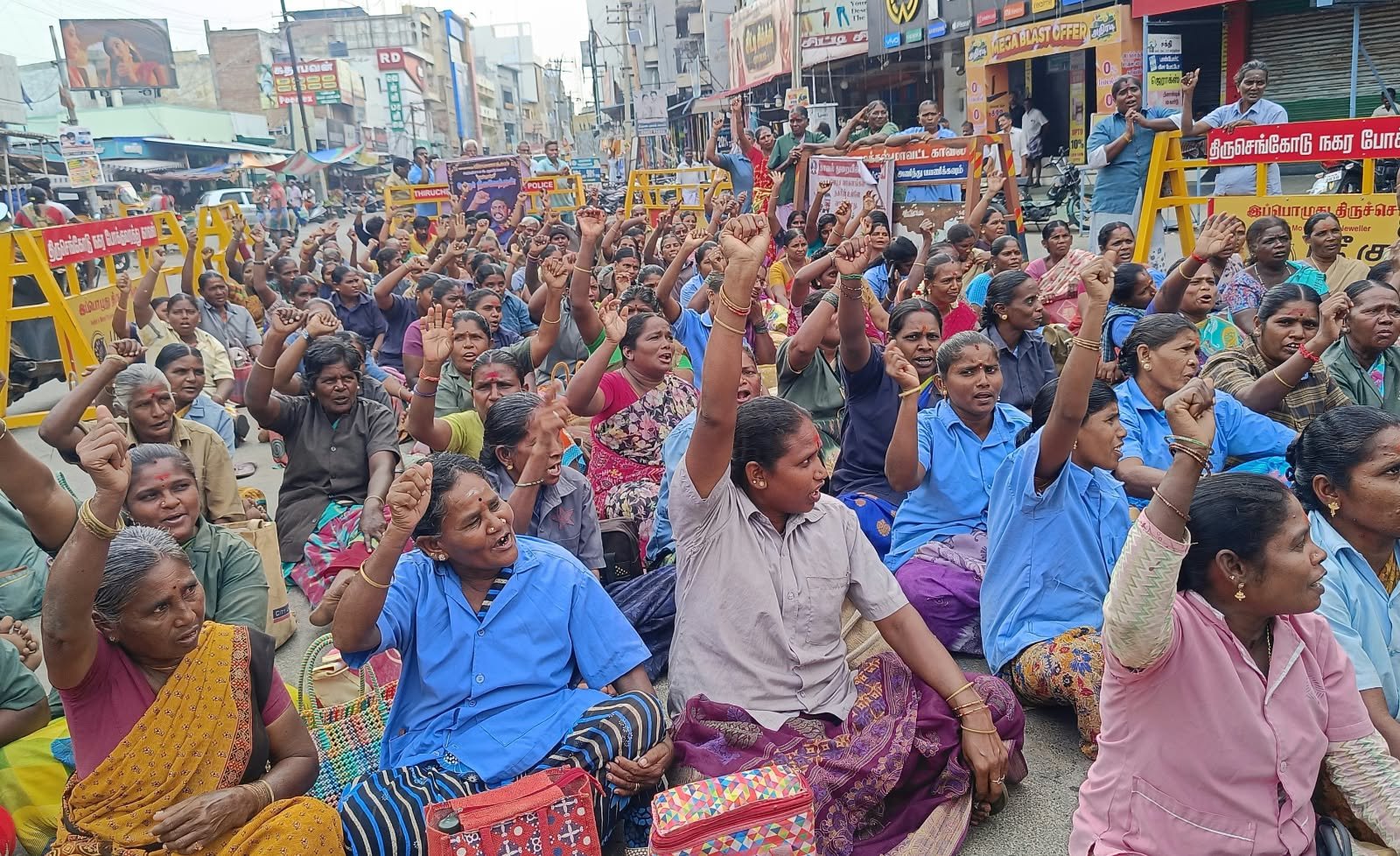
The Women Who Clean Tiruchengode Have Downed Their Brooms: Contract Sanitation Workers Demand Permanent Jobs, Fair Pay
Contract sanitation workers of Tiruchengode municipality in Namakkal district boycotted work and staged a protest in front of the Anna statue, demanding job regularization and a wage hike — the latest flare-up in Tamil Nadu's long war over the exploitation of sanitation labour, fought mostly by women.
· 2 min read

Five coffins in an SEZ: the industrial accident as management ritual
The Sri City boiler blast killed five workers — and India's fixed ritual has begun: condolences, a price list, a committee, and the company's 'safety protocols'. Periyar taught that power always finds a theory of its own innocence; here it is called a 'lapse'.
· 2 min read